

Table of Contents
Introduction
The forums are noisy, the advice is contradictory, and the stakes are high. If you are sifting through hundreds of threads looking for a definitive OSCP Certification Guide for 2026, you are likely overwhelmed by the sheer volume of “Try Harder” memes and conflicting study paths.
You are not alone. The journey to becoming an Offensive Security Certified Professional (OSCP) is notoriously grueling, serving as the gatekeeper for many entry-level penetration testing roles. However, vendor documentation often lacks the practical nuance found in community discussions.
CyberPhiLearn has analyzed thousands of user reports, exam reviews, and technical discussions from the cybersecurity community to build this guide. We bridge the gap between OffSec’s official syllabus and the tactical reality reported by candidates on the ground.
Below is your data-driven blueprint to conquering the PEN-200 in 2026.
Understanding the Core Concepts of the OSCP Certification
Before optimizing your study path, it is critical to understand what the OSCP actually represents in the current threat landscape. It is no longer just about popping a shell; it is about methodology, persistence, and documentation.
The Evolution of PEN-200
The OSCP has evolved significantly from its early days of simple buffer overflows and isolated machines. Analysis of the 2025 exam structure reveals a distinct shift toward Active Directory (AD) exploitation and realistic corporate network simulation.
Analyst Note: Do not rely on exam reviews older than late 2023. The introduction of the “OSCP+” designation and the shift in bonus point structures have fundamentally changed the optimal preparation strategy.
The “Try Harder” Philosophy vs. Methodology
The community slogan “Try Harder” is often misinterpreted as “bang your head against the wall until it breaks.”
Discussions in the security community highlight a different interpretation: “Try Differently.”
Success in 2026 is not about brute force; it is about enumeration. If you are stuck, you haven’t looked hard enough, or you are looking in the wrong place.
The 2026 Exam Format Breakdown
To prepare effectively, you must understand the scoring metrics in this OSCP Certification Guide for 2026.
| Component | Points | Requirement | Notes |
|---|---|---|---|
| Active Directory Set | 40 Points | Mandatory Path | Usually involves 2 clients and 1 Domain Controller. You pass or fail largely on this. |
| Standalone Targets | 20 Points Each | 3 Targets Total | Linux/Windows mix. Varies in difficulty. |
| Bonus Points | 10 Points | Optional (Highly Recommended) | Requires 80% completion of exercises + 30 lab machines. |
| Passing Score | 70 Points | — | AD Set + 30 points (Bonus + 1 Standalone) = Pass. |
Key Differences Analyzed: The Community Consensus
When browsing cybersecurity forums and community hubs, three major debates dominate the conversation. We analyzed the arguments to provide a clear verdict for your OSCP Certification Guide for 2026 journey.
1. The Lab Wars: HTB vs. THM vs. Proving Grounds
Where should you spend your money? Community data suggests a tiered approach is superior to sticking to a single platform.
TryHackMe (THM):
- Role: The Kindergarten/Elementary School.
- Verdict: Excellent for absolute beginners. The “Offensive Pentesting” path is frequently cited as the best pre-requisite before buying the PEN-200 course.
- Limitation: Too much hand-holding. It does not teach the frustration tolerance required for the actual exam.
Hack The Box (HTB):
- Role: The Gym.
- Verdict: Great for keeping skills sharp, but often “CTF-y” (Capture The Flag style).
- Limitation: Real-world exploits are rarely as puzzle-like as some HTB machines. Relying solely on HTB can lead to “Rabbit Hole” syndrome during the real exam.
OffSec Proving Grounds (PG) Practice:
- Role: The Simulator.
- Verdict: The highest correlation to exam success. These machines are created by OffSec. They mimic the “feel” and enumeration style of the exam perfectly.
- Community Consensus: “If you can consistently root PG Practice machines rated ‘Intermediate’ and ‘Hard’ without hints, you are exam-ready.”
2. The Note-Taking Dilemma: Obsidian vs. CherryTree
For years, CherryTree was the standard. However, the 2025 data shows a massive migration to Obsidian.
| Feature | Obsidian | CherryTree | Why it Matters |
|---|---|---|---|
| Searchability | Instant, Global | Slower | In the exam, finding a syntax command in 2 seconds vs 20 seconds adds up. |
| Format | Markdown | XML | Markdown is the industry standard for documentation (Git, etc.). |
| Syncing | Git/Cloud easy | Difficult | Losing notes due to corruption is a top fear reported on forums. |
| Templates | Powerful | Basic | You need templates for your Exam Report. |
Expert Recommendation: Switch to Obsidian. Use community-created templates (like the “OSCP Obsidian Template” found on GitHub) to automate your reporting structure.
3. Tools of the Trade: AutoRecon vs. Manual
Should you use automated enumeration scripts?
The consensus: Yes, but with a warning.
Tools like AutoRecon or NmapAutomator are essential for the initial 15 minutes of the exam. However, relying on them blinds you.
- The Trap: Users report staring at a screen waiting for a script to finish while missing an obvious open port 80.
- The Fix: Run automation in the background. Manually poke at high-value ports (80, 443, 445) immediately.
Deep Dive: The Active Directory (AD) Hurdle
If you fail AD, you likely fail the exam. This is the bottleneck for 70% of candidates who post “I failed” stories.
Why Candidates Fail AD
Analysis of failure reports indicates three primary deficiencies:
- Pivoting: Candidates can compromise the entry machine but fail to tunnel traffic to reach the internal network.
- Lateral Movement: Inability to use tools like
Ligolo-ngorChiseleffectively. - Enumeration Blindness: Focusing on exploits rather than credentials. In AD, Creds are King.
The “Golden Triangle” of AD Study
To master AD for the 2026 exam, focus your energy on these three pillars:
- Ligolo-ng:
- This tool has replaced Chisel as the community favorite for pivoting. It creates a tun interface, making pivoting feel like a local network connection.
- Action: Set up a home lab and practice double-pivoting until it is muscle memory.
- BloodHound:
- You must understand how to ingest data and query the graph.
- Key Query: “Find Shortest Path to Domain Admin.”
- Impacket Suite:
psexec,wmiexec, andsecretsdump. You need to know these flags by heart.
Analyst Note: Recent exam takers report that “Buffer Overflow” is no longer the guaranteed standalone machine it used to be. Do not over-index on Buffer Overflow at the expense of Active Directory practice.
Expert Recommendation: The 2026 Study Roadmap
Based on our analysis of successful candidates, here is the optimized path to certification in this OSCP Certification Guide for 2026.
Phase 1: The Foundation (1-2 Months)
- Goal: Fluency in Linux and Networking.
- Resource: TryHackMe (Complete Beginner & Jr Penetration Tester paths).
- Milestone: You can write a basic bash script and understand subnetting without Googling.
Phase 2: The Course Material (2-3 Months)
- Goal: 100% Topic Coverage & Bonus Points.
- Strategy: Purchase the Learn One bundle if budget allows (1 year access).
- Task: Complete 80% of the exercises. This is tedious but guarantees you the 10 bonus points.
- Task: Root 30 lab machines in the challenge labs.
- Why: Starting the exam with 10 points means you only need the AD Set (40) + 1 Standalone (20) to pass. This is a massive psychological advantage.
Phase 3: The “Proving Grounds” Gauntlet (1 Month)
- Goal: Speed and Methodology.
- Resource: OffSec Proving Grounds (Practice Tier).
- Method: Do one machine per day. Time yourself.
- Rule: If you don’t root it in 3 hours, look at the walkthrough, understand why you missed it, and document the methodology in Obsidian.
Phase 4: The Mock Exams (2 Weeks)
- Goal: Stamina.
- Activity: Simulate the 24-hour exam.
- Setup: Pick 3 Hard PG machines and an AD set from the course labs. Start at 8:00 AM. Do not stop until you have rooted them or time runs out.
- Critical: Write the report. Many fail not because they didn’t hack the box, but because their report was insufficient.
Common Pitfalls & How to Avoid Them
1. The “Rabbit Hole”
Symptom: You spend 4 hours trying to exploit a specific version of Apache because searchsploit showed a result.
Community Fix: The “30-Minute Rule.” If you have made no progress on a specific vector in 30 minutes, you must rotate. Go back to enumeration. Check a different port. Reset your mental state.
2. Report Fatigue
Symptom: You root everything but are too exhausted to write the report.
Community Fix: Screenshot AS YOU GO. Do not save screenshots for the end.
- Requirement: Screenshot of the proof.txt.
- Requirement: Screenshot of the
ipconfig/idcommand. - Requirement: Screenshot of the exploit running.
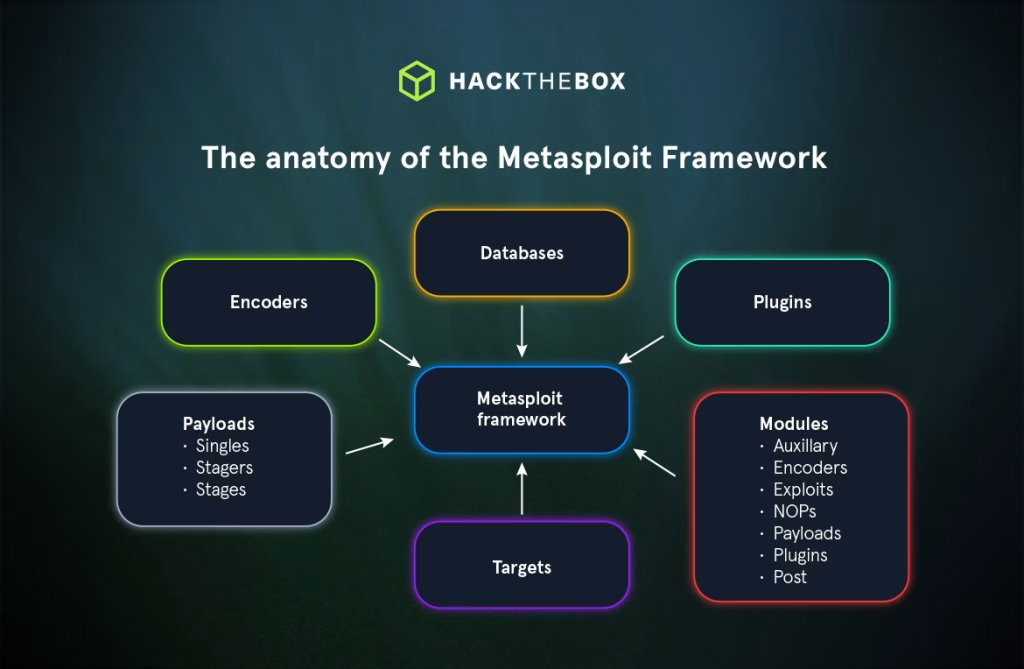
3. Dependency on Metasploit
Symptom: You use Metasploit for everything.
Limit: You are restricted on how many times you can use Metasploit (Meterpreter) in the exam (usually once).
Fix: Learn manual exploitation. If an exploit exists in Metasploit, a Python script likely exists on GitHub. Learn to read and modify Python code.
Frequently Asked Questions
Is the OSCP worth it in 2026?
Yes. While certifications like CPTS (HackTheBox) are technically excellent, HR departments and government contracts still prioritize OSCP as the mandatory filter. It is the industry standard for employability.
How much Python do I need to know for the OSCP Certification?
You do not need to be a developer. You need to be able to read a script, understand what it does (so you don’t run malware), and modify IP addresses/ports within the code.
Can I use Chat-GPT during the exam?
Strictly No. Using AI assistants to generate payloads or write reports during the exam is a violation of OffSec terms and can lead to a lifetime ban. You may use it for study before the exam, but during the 23h 45m window, it is just you and your notes.
What happens if the VPN drops?
It happens. Remain calm. Pause the proctoring software if instructed, troubleshoot your connection, and request technical support. This is part of the stress test.
Conclusion
The OSCP is a test of enumeration and persistence. It forces you to verify every assumption and document every step. This OSCP Certification Guide for 2026 has provided you with the tactical framework to succeed.
- Secure the Bonus Points.
- Master Active Directory (Ligolo-ng is your friend).
- Live in Proving Grounds Practice.
- Document everything in Obsidian.
The certification is not just a badge; it is proof that you can suffer through a problem and emerge with a solution. That is the skill employers are buying.
Stay secure, and good luck.